Introduction
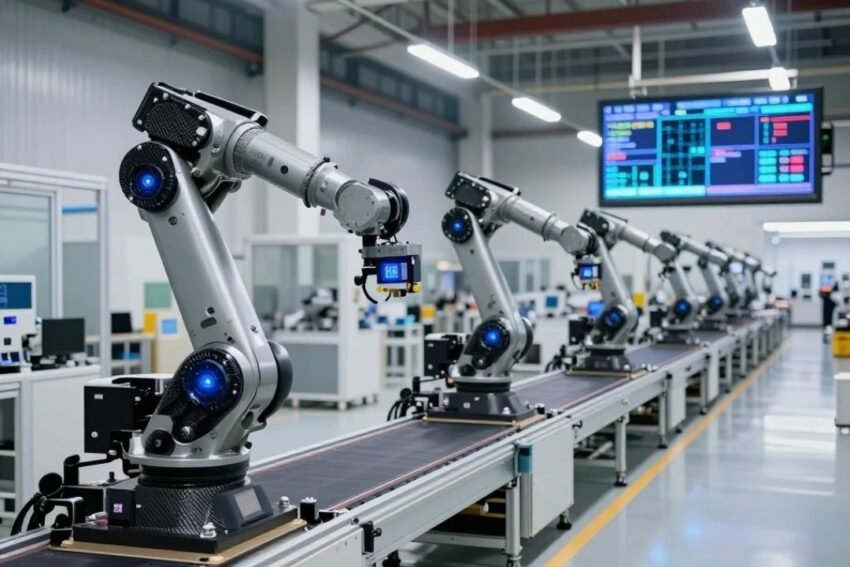
AI-powered robotics in 2026 is transforming the way businesses, factories, hospitals, farms, warehouses, and research organizations operate. By combining artificial intelligence with robotics, modern machines can perform tasks with greater flexibility, analyze their surroundings, recognize objects, and respond to changing conditions.
Traditional robots were often programmed to perform the same actions repeatedly in controlled environments. Today, advances in machine learning, computer vision, natural-language processing, sensors, and edge computing are helping robots become more adaptable.
AI-powered robots can process information from cameras and sensors, understand patterns, make decisions, and perform increasingly complex tasks. This does not mean robots can independently handle every situation, but it does mean that robotic systems are becoming more useful outside traditional industrial environments.
From smart manufacturing to healthcare, logistics, agriculture, construction, and household applications, AI and robotics are creating new opportunities for automation.
This article explores how AI-powered robotics is changing industries in 2026, the latest applications, benefits, challenges, emerging technologies, career opportunities, and the future of intelligent machines.
What Is AI-Powered Robotics?
AI-powered robotics combines physical robotic systems with artificial intelligence technologies.
A traditional robot may follow a predefined sequence of instructions. An AI-powered robot can use data from sensors and software models to interpret its environment and determine an appropriate action.
AI can help robots perform tasks such as:
- Object recognition
- Navigation
- Path planning
- Speech understanding
- Image analysis
- Anomaly detection
- Task planning
- Predictive maintenance
The combination of AI and robotics creates machines that can potentially adapt to environments that are more unpredictable than traditional automated production lines.
Why AI Is Important for Robotics in 2026
Artificial intelligence is becoming a major component of modern robotic systems because robots increasingly need to operate in dynamic environments.
AI can help robots understand:
- What objects are around them
- Where obstacles are located
- Which task should happen next
- How objects can be manipulated
- Whether an operation appears normal
- How to respond to changing conditions
This intelligence can make robots more flexible and useful.
1. AI-Powered Manufacturing
Manufacturing is one of the most important areas for AI-powered robotics.
Factories can use intelligent robots for:
- Assembly
- Welding
- Painting
- Packaging
- Material handling
- Inspection
AI can analyze production information and help identify unusual patterns.
For example, computer vision systems can inspect products and detect defects during production.
This can improve consistency while reducing the amount of manual inspection required for certain tasks.
2. Smart Factories
The combination of robotics, sensors, AI, and connected systems is helping create smart factories.
A smart factory can collect information from machines and production lines.
AI can analyze this information to help organizations understand:
- Production performance
- Equipment conditions
- Quality problems
- Energy usage
- Maintenance requirements
Robots can then operate as part of a larger connected production system.
3. AI-Powered Warehouse Robots
Warehouses are increasingly adopting robotic automation.
AI-powered warehouse robots can help move goods and optimize workflows.
Applications include:
- Picking
- Sorting
- Transportation
- Packing
- Inventory management
Computer vision can help robots recognize packages and products.
AI can also help robotic fleets determine efficient routes through warehouse environments.
4. Autonomous Mobile Robots
Autonomous Mobile Robots, or AMRs, can navigate spaces without following a fixed physical track.
They may use:
- Cameras
- LiDAR
- Radar
- Mapping systems
- AI algorithms
AMRs can detect obstacles and adjust routes.
This makes them particularly useful for warehouses, factories, hospitals, and other large facilities.
5. Healthcare Robotics
AI-powered robotics is also becoming increasingly important in healthcare.
Robotic systems can support:
- Surgery
- Rehabilitation
- Patient assistance
- Hospital logistics
- Laboratory operations
AI can help process medical or operational data, while robotic systems provide physical capabilities.
Healthcare robotics requires particularly strong safety controls because mistakes can have serious consequences.
6. AI-Assisted Surgical Robotics
Surgical robotics can provide doctors with precise instruments and enhanced control.
AI may assist with certain aspects of:
- Image analysis
- Surgical planning
- Instrument positioning
- Data interpretation
However, medical professionals remain responsible for clinical decisions.
AI-assisted systems should be carefully validated and operated under appropriate medical supervision.
7. Rehabilitation Robots
Robotic systems can support physical rehabilitation.
They may provide controlled and repeatable movements for patients recovering from injuries or medical conditions.
Potential applications include:
- Walking assistance
- Movement training
- Repetitive exercises
- Mobility support
AI can potentially personalize aspects of robotic assistance based on collected data.
8. Agricultural Robotics
Agriculture is another industry where AI-powered robotics can have a significant impact.
Robots can assist with:
- Crop monitoring
- Weed identification
- Harvesting
- Planting
- Field inspection
Computer vision can help identify crops and distinguish plants from weeds.
AI can then support targeted actions.
9. AI-Powered Weed Detection
Weed management can require substantial labor.
Agricultural robots equipped with cameras can scan crops and identify potential weeds.
AI-based computer vision can classify images and help robotic systems determine where action may be required.
This can support precision agriculture by focusing resources on specific areas instead of treating an entire field uniformly.
10. Robotic Harvesting
Harvesting can be challenging because crops vary in size, position, shape, and ripeness.
AI-powered robots can use cameras and sensors to identify objects and estimate their location.
Robotic arms can then attempt to pick or handle suitable produce.
The technology is developing, but real-world agricultural environments remain challenging for robotics.
11. Construction Robotics
Construction sites are dynamic environments.
AI-powered robots may support:
- Surveying
- Inspection
- Material handling
- Bricklaying
- Repetitive construction tasks
AI can help machines interpret construction environments and identify objects or obstacles.
Drones can also complement construction robotics by collecting aerial information.
12. AI and Construction Drones
Drones equipped with cameras and AI can analyze construction sites.
They can support:
- Site mapping
- Progress monitoring
- Surveying
- Inspection
- Measurement
AI can process aerial imagery to identify changes over time.
This can give project teams better visibility into large construction sites.
13. Logistics Automation
Logistics companies are looking for ways to move goods efficiently.
AI-powered robots can help coordinate:
- Warehouses
- Sorting centers
- Transportation systems
- Inventory operations
AI can analyze large amounts of operational data and help optimize robotic workflows.
14. AI-Powered Delivery Robots
Autonomous delivery robots are being explored for certain local delivery applications.
Potential uses include:
- Food delivery
- Grocery delivery
- Small packages
- Campus transportation
The practical deployment of delivery robots depends on regulations, pedestrian environments, safety systems, weather, and local infrastructure.
15. Humanoid Robots
Humanoid robots are among the most visible areas of robotics development.
These machines are designed with human-like body structures.
Potential applications include:
- Manufacturing
- Warehousing
- Hospitality
- Research
- Household assistance
The appeal of humanoid robots is partly based on their ability to operate in environments designed for human workers.
However, achieving reliable general-purpose physical intelligence remains a significant engineering challenge.
16. Natural-Language Robot Interaction
AI language technologies can make robots easier to interact with.
Instead of requiring specialized commands, users may increasingly communicate with robots through natural language.
For example, a user could provide a high-level instruction, and an AI system could translate it into a sequence of robotic actions.
Reliable execution requires safeguards to ensure the robot understands the instruction correctly and operates safely.
17. AI Computer Vision
Computer vision is one of the most important technologies behind intelligent robotics.
Cameras can provide robots with information about their environment.
AI models can analyze visual data to identify:
- Objects
- People
- Obstacles
- Products
- Surfaces
- Environmental conditions
This allows robots to make more informed decisions.
18. LiDAR and Sensor Fusion
Robots can use multiple types of sensors.
These may include:
- Cameras
- LiDAR
- Radar
- Ultrasonic sensors
- GPS
- Inertial measurement systems
Combining multiple sensor types is often called sensor fusion.
Sensor fusion can provide robots with a richer understanding of their surroundings.
19. Edge AI in Robotics
Edge AI allows artificial intelligence processing to happen directly on or near a robotic device.
This can reduce reliance on remote servers for certain decisions.
Potential advantages include:
- Lower latency
- Faster responses
- Reduced network dependency
- Greater operational independence
Edge AI can be particularly useful when robots need to react quickly.
20. Predictive Maintenance
AI can help organizations predict potential robotic equipment failures.
Robots generate operational information such as:
- Motor activity
- Temperature
- Vibration
- Battery status
- Error events
AI systems can analyze patterns and potentially identify signs of developing problems.
Predictive maintenance can help reduce unexpected downtime.
21. AI-Powered Quality Control
Quality control is another major application.
Robotic inspection systems can use computer vision to analyze products.
They may detect:
- Scratches
- Missing components
- Incorrect assembly
- Surface defects
- Shape inconsistencies
AI-powered inspection can operate at high speeds in suitable production environments.
22. Robots in Retail
Retail businesses may use robots for certain operational tasks.
Possible applications include:
- Inventory scanning
- Shelf monitoring
- Warehouse operations
- Customer assistance
AI can help robots identify products and interpret store environments.
Human employees remain important for customer service and complex situations.
23. Hospitality Robots
Hotels and restaurants are experimenting with service robotics.
Potential tasks include:
- Delivering items
- Room service assistance
- Cleaning
- Information services
AI can make interactions more natural.
However, hospitality requires social understanding and flexibility, so robots may be best suited to clearly defined tasks.
24. Household AI Robots
The home is one of the most difficult environments for general-purpose robotics.
Homes contain:
- Different furniture
- People
- Pets
- Objects
- Narrow spaces
- Changing layouts
AI can help robots understand these environments.
Future household robots may eventually assist with a broader range of tasks, although affordability, reliability, safety, and privacy remain important challenges.
25. Robotics in Space Exploration
AI-powered robots are especially valuable in space exploration.
Robots can operate in environments where humans face significant risks.
AI can support:
- Navigation
- Scientific analysis
- Object identification
- Autonomous decision-making
As missions become more distant from Earth, autonomous capabilities can become increasingly important because communication delays limit real-time human control.
26. Underwater AI Robotics
Underwater robots can operate in difficult environments.
AI can help analyze sensor information and identify objects or environmental changes.
Potential applications include:
- Ocean research
- Infrastructure inspection
- Environmental monitoring
- Scientific exploration
Underwater robotics can help researchers gather information without requiring humans to operate directly in challenging environments.
27. Robotics and Cybersecurity
As robots become more connected, cybersecurity becomes increasingly important.
Potential risks include:
- Unauthorized access
- Data theft
- Software vulnerabilities
- Manipulation of robotic commands
Security should be considered throughout the robotic system’s lifecycle.
Important practices can include:
- Authentication
- Encryption
- Access control
- Secure software updates
- Network segmentation
- Monitoring
28. Human-Robot Collaboration
AI-powered robotics is not necessarily about replacing every human worker.
A major opportunity is human-robot collaboration.
Humans can provide:
- Creativity
- Judgment
- Communication
- Complex decision-making
Robots can provide:
- Repetition
- Precision
- Physical strength
- Consistent execution
Combining these strengths can create more productive workplaces.
29. Robotics-as-a-Service
Robotics-as-a-Service allows organizations to access robotic capabilities through service-based models.
This can potentially reduce the upfront cost of automation.
Businesses may pay for robotic services instead of purchasing and maintaining all hardware themselves.
RaaS could make robotics more accessible to smaller organizations.
30. The Future of AI-Powered Robotics
The future of AI-powered robotics is likely to focus on greater intelligence, autonomy, adaptability, and safety.
Future robots may become better at:
- Understanding natural language
- Recognizing objects
- Navigating unfamiliar environments
- Planning multi-step tasks
- Learning from experience
- Collaborating with humans
The combination of AI models, advanced sensors, edge computing, robotics hardware, and cloud systems could create increasingly capable machines.
Benefits of AI-Powered Robotics
AI-powered robots offer several potential advantages.
Increased Productivity
Robots can automate repetitive operations.
Improved Precision
Machines can perform certain tasks consistently.
Enhanced Safety
Robots can perform some hazardous tasks.
Faster Data Processing
AI can analyze large amounts of sensor information.
Reduced Repetitive Labor
Automation can reduce certain physically repetitive activities.
Greater Flexibility
AI can make robots more adaptable than traditional fixed automation.
Challenges of AI-Powered Robotics
Despite rapid development, several challenges remain.
High Development Costs
Advanced robotic systems can be expensive to develop and deploy.
Safety
Robots operating around humans must be carefully designed and tested.
AI Reliability
AI models can make incorrect predictions or decisions.
Cybersecurity
Connected robots can create additional security risks.
Battery Limitations
Mobile robots often require efficient power systems.
Complex Environments
Real-world environments are much harder than controlled laboratories.
Workforce Changes
Automation can change job responsibilities and create demand for new technical skills.
Skills for Future Robotics Careers
People interested in AI-powered robotics can develop skills in:
- Python
- C++
- Artificial intelligence
- Machine learning
- Computer vision
- Robotics
- Electronics
- Mechanical engineering
- Embedded systems
- Control systems
- Data science
Combining software and hardware knowledge can provide a strong foundation.
Robotics Career Opportunities
AI-powered robotics can create opportunities for:
- Robotics Engineers
- AI Engineers
- Robotics Software Developers
- Computer Vision Engineers
- Automation Engineers
- Embedded Systems Engineers
- Robotics Technicians
- Machine Learning Engineers
- Autonomous Systems Engineers
- Research Scientists
As robotics expands, interdisciplinary skills will become increasingly valuable.
Frequently Asked Questions
What is AI-powered robotics?
AI-powered robotics combines robotic hardware with artificial intelligence to help machines perceive environments, analyze information, make decisions, and perform physical tasks.
How is AI changing robotics?
AI is helping robots recognize objects, navigate environments, plan tasks, analyze data, and interact with people.
What industries use AI-powered robots?
Manufacturing, healthcare, agriculture, logistics, construction, retail, hospitality, research, and space exploration are among the industries using or developing intelligent robotic systems.
Will AI robots replace humans?
AI-powered robots can automate specific tasks, but humans remain important for creativity, judgment, communication, supervision, and complex decision-making.
What skills are needed for robotics?
Programming, AI, machine learning, computer vision, electronics, mechanical engineering, and control systems are useful skills.
Are humanoid robots the future?
Humanoid robots have significant potential, but their widespread adoption depends on reliability, safety, cost, battery performance, and practical usefulness.
Conclusion
AI-powered robotics in 2026 represents one of the most important developments in modern technology. By combining artificial intelligence with advanced robotic hardware, machines are becoming more capable of understanding their surroundings, analyzing information, navigating environments, and performing complex physical tasks.
Manufacturing remains a major area of robotic innovation, with smart factories using AI, sensors, computer vision, and automation to improve production and quality control.
Warehouses and logistics operations are also benefiting from autonomous mobile robots that can move goods and optimize workflows.
Healthcare robotics offers another important opportunity. Robotic systems can support surgery, rehabilitation, hospital logistics, and laboratory operations. Because healthcare involves significant risks, these technologies require careful validation, professional supervision, and strong safety controls.
Agriculture is using robotics and AI to monitor crops, identify weeds, improve precision operations, and explore automated harvesting.
Construction and infrastructure industries can also benefit from robots and AI-powered drones that inspect sites, collect data, and automate repetitive tasks.
Humanoid robots are attracting attention because of their potential ability to work in human-designed environments. However, building reliable general-purpose robots remains a difficult technical challenge.
One of the most important trends is the integration of AI, computer vision, sensors, edge computing, and natural-language interfaces. These technologies can make robots more flexible and easier for humans to interact with.
At the same time, intelligent robotics introduces challenges involving cybersecurity, privacy, reliability, safety, cost, battery life, and workforce adaptation.
The future of robotics is therefore likely to focus not simply on creating machines that can perform more tasks, but on developing robots that can perform useful tasks safely, reliably, efficiently, and collaboratively.
AI will continue to play a major role, but human expertise will remain essential. Engineers, developers, technicians, operators, and researchers will be needed to design, supervise, maintain, and improve robotic systems.
For people preparing for future technology careers, learning programming, AI, machine learning, computer vision, robotics, electronics, and automation can provide a strong foundation.
As AI-powered machines become more capable, robotics could transform how industries manufacture products, move goods, grow food, provide healthcare, inspect infrastructure, and explore challenging environments.
The future of robotics is ultimately about creating a partnership between human intelligence and machine capability. When designed responsibly, AI-powered robots can help organizations improve productivity, reduce dangerous or repetitive work, collect better information, and solve problems that are difficult for humans to handle alone.
In 2026 and beyond, the combination of artificial intelligence and robotics will remain a powerful force shaping the future of automation and intelligent machines.