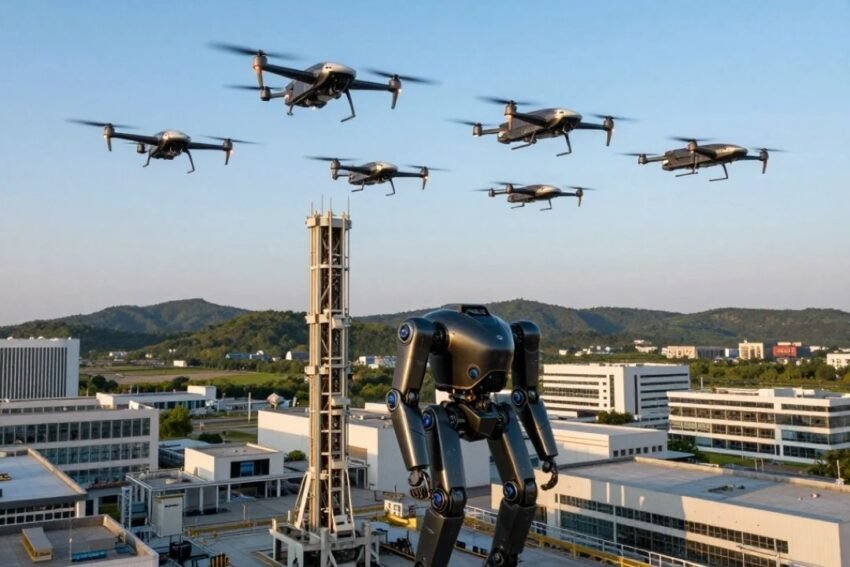
Introduction
The future of robotics and drones is expected to bring major changes to industries, businesses, cities, agriculture, transportation, healthcare, and everyday life. Advances in artificial intelligence, machine learning, computer vision, sensors, robotics hardware, batteries, connectivity, and automation are making intelligent machines increasingly capable.
Robots can already perform repetitive industrial tasks, move goods in warehouses, assist healthcare professionals, monitor agricultural fields, and support scientific research. Drones are being used for photography, surveying, mapping, agriculture, infrastructure inspection, environmental monitoring, emergency response, and specialized logistics.
The next stage of development will focus on making these systems more autonomous, intelligent, adaptable, connected, and reliable.
Instead of simply following fixed instructions, future robots and drones may be able to understand their surroundings, interpret natural-language commands, plan multi-step tasks, and adapt to changing environments.
This article explores the future of robotics and drones beyond 2026, including AI-powered machines, autonomous drones, humanoid robots, smart factories, healthcare robotics, agricultural automation, drone delivery, edge AI, robotics-as-a-service, cybersecurity, emerging technologies, career opportunities, and the challenges that could influence adoption.
What Is the Future of Robotics and Drones?
The future of robotics and drones involves increasingly intelligent machines that can perform physical tasks with less direct human control.
Robotics focuses primarily on machines that interact with the physical world, while drones are unmanned aircraft capable of remote or autonomous operation.
Both technologies are increasingly connected to:
- Artificial intelligence
- Machine learning
- Computer vision
- Cloud computing
- Edge computing
- Advanced sensors
- Wireless networks
- Automation platforms
The combination of these technologies can create intelligent systems capable of collecting information, making decisions, and performing physical actions.
1. AI Will Drive Robotics Innovation
Artificial intelligence is likely to remain one of the biggest forces shaping robotics.
AI can help robots process information from cameras, microphones, LiDAR, radar, and other sensors.
Future AI-powered robots may become better at:
- Recognizing objects
- Understanding environments
- Planning tasks
- Navigating spaces
- Predicting outcomes
- Interacting with humans
This could make robots useful in more unpredictable environments.
2. More Autonomous Drones
Drones are expected to become increasingly autonomous.
Instead of requiring continuous manual control, future drones may perform complete missions based on predefined objectives.
Potential capabilities include:
- Autonomous takeoff
- Route planning
- Obstacle avoidance
- Automated landing
- Object tracking
- Mission management
- Return-to-base operations
Human oversight will remain important for safety and regulatory compliance.
3. Humanoid Robots
Humanoid robots are one of the most visible areas of robotics development.
These robots are designed to operate using human-like body structures.
Their potential applications include:
- Manufacturing
- Warehousing
- Retail
- Hospitality
- Research
- Household assistance
One reason humanoid robots are attractive is that they could operate in environments already designed for human workers.
However, widespread adoption depends on cost, reliability, safety, battery life, and practical performance.
4. AI Agents and Physical Robots
AI agents may become increasingly connected to physical machines.
An AI agent could potentially interpret a user’s request and coordinate robotic actions.
For example, a user might provide a high-level instruction, and the AI system could determine the sequence of physical tasks needed to complete it.
This could create new forms of human-machine interaction.
However, physical AI systems require strict safeguards because incorrect instructions or decisions can have real-world consequences.
5. Smart Manufacturing
Factories are likely to become more automated.
Smart manufacturing combines:
- Robots
- AI
- Sensors
- Industrial software
- Data analytics
- Automated production systems
AI can analyze production information and identify patterns that may indicate quality or maintenance problems.
Robots can then perform repetitive production activities with high consistency.
6. Collaborative Robots
Collaborative robots, or cobots, are designed to work alongside people in appropriate environments.
Future cobots may become more intelligent and flexible.
They could potentially:
- Assist workers
- Move materials
- Perform assembly
- Inspect products
- Handle repetitive tasks
Human workers can focus on activities requiring judgment, creativity, and communication.
7. Autonomous Mobile Robots
Autonomous Mobile Robots can navigate facilities without relying on fixed tracks.
Future AMRs may use AI, cameras, LiDAR, and other sensors to navigate complex environments.
Potential applications include:
- Warehouses
- Hospitals
- Airports
- Factories
- Retail facilities
As navigation technology improves, these robots could become more flexible.
8. Warehouse Automation
The growth of e-commerce and global logistics will continue to create demand for automation.
Robots can help with:
- Picking
- Sorting
- Packing
- Transportation
- Inventory
AI can coordinate multiple machines and optimize warehouse workflows.
Future warehouses may combine robotic arms, autonomous mobile robots, computer vision, and automated storage systems.
9. AI-Powered Agricultural Robots
Agriculture is likely to become increasingly automated.
Robots can support:
- Planting
- Weeding
- Crop monitoring
- Harvesting
- Field inspection
AI-powered computer vision can help robots identify plants, weeds, fruits, and other objects.
This can support precision agriculture and potentially reduce repetitive labor.
10. Agricultural Drones
Drones can provide farmers with detailed aerial information.
Future agricultural drones may use AI to analyze:
- Crop health
- Irrigation conditions
- Pest damage
- Plant growth
- Soil-related patterns
Automated drone missions could regularly collect data and provide farmers with updated information.
11. Autonomous Drone Delivery
Drone delivery is likely to remain an important area of research and commercial development.
Potential delivery applications include:
- Small packages
- Food
- Medical supplies
- Emergency equipment
Autonomous delivery systems will require reliable navigation, communication, airspace management, and safety systems.
Regulations will play a major role in determining how widely drone delivery can expand.
12. Medical Drone Networks
Drones may become increasingly useful for specialized healthcare logistics.
They could potentially transport:
- Laboratory samples
- Medical equipment
- Emergency supplies
- Certain temperature-sensitive products
Drones could be particularly valuable in remote or difficult-to-reach areas.
However, medical logistics requires strong reliability and regulatory oversight.
13. Healthcare Robotics
Healthcare robotics is expected to grow as robotic systems become more capable.
Future applications could include:
- Surgical assistance
- Rehabilitation
- Patient mobility
- Hospital transportation
- Laboratory automation
Robots can perform repetitive physical tasks while healthcare professionals focus on clinical and human-centered responsibilities.
14. AI-Assisted Surgery
AI and robotics may become increasingly integrated into surgical systems.
AI could support certain tasks involving:
- Image analysis
- Surgical planning
- Instrument positioning
- Data processing
Medical professionals will remain essential for clinical judgment and patient care.
15. Robots for Elderly Assistance
An aging population in many parts of the world could increase interest in assistive robotics.
Future robots may provide support with:
- Mobility
- Reminders
- Household tasks
- Communication
- Monitoring
These systems must be designed around privacy, safety, dignity, and user control.
16. Construction Robotics
Construction is another industry where robotics and drones can work together.
Ground robots could perform repetitive tasks, while drones collect aerial data.
Potential applications include:
- Surveying
- Site mapping
- Inspection
- Material handling
- Progress monitoring
Combining aerial and ground robotics can provide a more complete view of construction operations.
17. Infrastructure Inspection
Future drones may increasingly inspect infrastructure automatically.
Potential targets include:
- Bridges
- Towers
- Solar farms
- Buildings
- Industrial facilities
- Pipelines
AI can analyze collected images and identify potential defects.
This can help organizations monitor large infrastructure networks more efficiently.
18. Environmental Monitoring
Drones and robots can help monitor the environment.
Applications may include:
- Forest monitoring
- Wildlife research
- Coastal observation
- Pollution analysis
- Disaster assessment
Autonomous systems can collect information across large areas without requiring continuous human operation.
19. Space Robotics
Robots will remain critical for space exploration.
Future robotic missions may involve:
- Autonomous exploration
- Sample collection
- Scientific experiments
- Construction
- Equipment maintenance
As spacecraft travel farther from Earth, communication delays can make autonomous decision-making increasingly important.
20. Underwater Robotics
Underwater robots can explore areas that are difficult or dangerous for humans.
Future systems may support:
- Ocean research
- Infrastructure inspection
- Environmental monitoring
- Deep-sea exploration
AI could help underwater robots navigate and analyze their surroundings.
21. Edge AI
Edge AI allows intelligent processing to occur close to where data is collected.
For robots and drones, this can reduce dependence on remote servers.
Potential benefits include:
- Faster decisions
- Lower latency
- Reduced network traffic
- Greater autonomy
Edge AI can be especially important when machines must react immediately to obstacles or environmental changes.
22. Advanced Sensor Fusion
Future machines will increasingly combine information from multiple sensors.
A robot may use:
- Cameras
- LiDAR
- Radar
- GPS
- Inertial sensors
- Thermal sensors
Sensor fusion can help create a more complete representation of the environment.
This can improve navigation, object detection, and autonomous decision-making.
23. Digital Twins
Digital twins create digital representations of physical systems.
Robots and drones can collect data that updates these models.
Digital twins can help organizations understand:
- Infrastructure
- Factories
- Buildings
- Equipment
- Construction sites
They can support monitoring, simulation, planning, and maintenance.
24. Robotics-as-a-Service
Robotics-as-a-Service could make advanced automation more accessible.
Instead of buying robotic systems outright, businesses may access robotics through service-based models.
This could benefit companies that:
- Have limited capital
- Need temporary automation
- Want flexible scaling
- Do not have specialized robotics teams
The RaaS model may become increasingly important as robotics becomes more service-oriented.
25. Cloud Robotics
Cloud robotics connects robots to cloud platforms.
Cloud systems can provide:
- Data storage
- Software updates
- Fleet management
- AI services
- Analytics
Robots can combine cloud resources with onboard processing.
This hybrid approach can provide flexibility while maintaining local capabilities.
26. 5G and Future Connectivity
Advanced wireless networks can improve communication between machines and control systems.
Robots and drones may use high-speed connectivity for:
- Teleoperation
- Data transfer
- Fleet management
- Cloud access
- Coordination
However, safety-critical systems should be designed to operate safely even when connectivity is interrupted.
27. Drone Swarms
Drone swarms involve multiple drones working together.
Future civilian applications could include:
- Environmental monitoring
- Large-area mapping
- Search operations
- Agricultural surveying
- Infrastructure inspection
Coordinating large groups of autonomous aircraft is technically complex and requires careful airspace and safety management.
28. Human-Robot Collaboration
The future workplace may increasingly involve people and robots working together.
Humans can handle:
- Creativity
- Judgment
- Communication
- Complex decisions
Robots can handle:
- Repetition
- Precision
- Heavy physical tasks
- Hazardous operations
This combination could improve productivity while reducing some forms of repetitive work.
29. Robotics Cybersecurity
As robots become connected, cybersecurity will become increasingly important.
Potential risks include:
- Unauthorized access
- Data theft
- Software vulnerabilities
- Manipulated commands
- Compromised communication
Future robotic systems will need strong security practices, including authentication, encryption, access controls, monitoring, and secure updates.
30. Privacy and Responsible Robotics
Robots and drones can collect large amounts of information.
Cameras and sensors can capture information about people, homes, workplaces, and public spaces.
Responsible deployment should consider:
- Privacy
- Data protection
- Consent
- Transparency
- Security
- Human oversight
Technology providers and organizations will need clear policies for responsible data collection.
31. Improved Robot Batteries
Battery life remains an important limitation for mobile robots and drones.
Future improvements may come from advances in:
- Battery chemistry
- Energy density
- Charging systems
- Power management
- Lightweight materials
Longer operating times could expand the range of possible applications.
32. New Materials for Robotics
Advanced materials could help create lighter and stronger machines.
Future robotic systems may use materials designed for:
- Low weight
- Durability
- Flexibility
- Heat resistance
Lightweight designs can improve energy efficiency and mobility.
33. Soft Robotics
Soft robotics focuses on machines made with flexible materials.
Unlike rigid industrial robots, soft robots can be designed to interact more gently with delicate objects.
Potential applications include:
- Food handling
- Healthcare
- Agriculture
- Human assistance
Soft robotics may become particularly useful where traditional rigid robotic mechanisms are difficult to apply.
34. Robotics in Education
Robotics can also play an important role in education.
Students can learn:
- Programming
- Engineering
- Electronics
- AI
- Problem-solving
Educational robotics platforms can provide hands-on experience with technology.
As AI becomes more important, robotics education could help students understand how software interacts with the physical world.
35. Future Robotics Careers
The expansion of robotics and drones can create new career opportunities.
Potential roles include:
- Robotics Engineer
- AI Engineer
- Drone Engineer
- Autonomous Systems Engineer
- Robotics Software Developer
- Computer Vision Engineer
- Automation Engineer
- Embedded Systems Engineer
- Robotics Technician
- Drone Data Specialist
People entering the field can benefit from combining technical and interdisciplinary skills.
Skills Needed for Future Robotics Jobs
Important skills may include:
Programming
Python and C++ are useful in many robotics applications.
Artificial Intelligence
Understanding machine learning and AI systems can be valuable.
Computer Vision
Vision technology helps machines interpret their surroundings.
Electronics
Knowledge of sensors, circuits, and embedded systems is important.
Mechanical Engineering
Robotic systems require mechanical design and motion control.
Data Analysis
Robots and drones generate large amounts of data.
Cybersecurity
Connected machines require strong security practices.
Benefits of Future Robotics and Drones
The development of intelligent machines can provide several advantages.
Increased Productivity
Robots can automate repetitive tasks.
Improved Safety
Machines can perform certain dangerous operations.
Better Data Collection
Drones can gather information across large areas.
Greater Precision
Robotic systems can perform certain tasks consistently.
Reduced Repetitive Work
Automation can reduce physically repetitive activities.
Faster Operations
Autonomous systems can operate efficiently in appropriate environments.
New Services
Robotics and drones can enable services that are difficult to provide using traditional methods.
Challenges of Robotics and Drones
The future also presents several challenges.
High Costs
Advanced robotic systems can require significant investment.
Safety
Machines must operate safely around humans.
Cybersecurity
Connected systems can create new attack surfaces.
Privacy
Sensors and cameras can collect sensitive information.
Regulations
Drone operations require compliance with applicable aviation and local rules.
Battery Limitations
Mobile machines remain constrained by energy capacity.
Reliability
Autonomous machines need to function correctly in unpredictable environments.
Workforce Adaptation
Workers may need new skills as automation changes job responsibilities.
What Will Robotics and Drones Look Like in the Future?
Future machines will likely become:
- More autonomous
- More intelligent
- More connected
- More energy efficient
- More adaptable
- More collaborative
Instead of operating as isolated machines, robots and drones may work as parts of connected systems.
A warehouse, for example, could include robotic arms, autonomous vehicles, drones, AI software, sensors, and cloud platforms working together.
Similarly, a smart farm could combine agricultural robots, autonomous drones, IoT sensors, AI analytics, and automated equipment.
Frequently Asked Questions
What is the future of robotics?
The future of robotics will likely involve greater autonomy, AI integration, advanced sensors, human-robot collaboration, cloud connectivity, and specialized automation.
Will robots become fully autonomous?
Some robots can already operate autonomously in controlled environments. More advanced autonomy is likely, but safety, reliability, regulation, and technical limitations will continue to influence deployment.
What is the future of drones?
Drones are likely to become more autonomous and useful for mapping, agriculture, inspection, emergency response, environmental monitoring, and specialized delivery.
Will humanoid robots become common?
Humanoid robots have significant potential, but widespread adoption depends on cost, reliability, safety, battery life, and practical performance.
How will AI affect robotics?
AI can help robots recognize objects, understand environments, navigate, plan tasks, and interact with humans.
What careers are available in robotics?
Robotics offers careers in engineering, AI, software development, computer vision, automation, electronics, embedded systems, data analysis, and drone technology.
Conclusion
The future of robotics and drones beyond 2026 is likely to be defined by artificial intelligence, automation, advanced sensors, autonomous systems, edge computing, improved connectivity, and human-machine collaboration.
Robots are already transforming manufacturing, logistics, healthcare, agriculture, construction, and research. Drones are expanding beyond photography into surveying, mapping, infrastructure inspection, environmental monitoring, agriculture, emergency response, and specialized logistics.
AI will remain one of the most important technologies behind this transformation. Intelligent software can help machines recognize objects, understand environments, plan actions, and respond to changing conditions.
Humanoid robots could eventually operate in environments designed for humans, while specialized robots will continue to dominate applications where automation provides clear benefits.
Autonomous mobile robots can transform warehouses and factories by moving materials and products without fixed paths. Collaborative robots can work alongside humans, performing repetitive tasks while workers focus on more complex responsibilities.
Agricultural robots and drones can support precision farming by monitoring crops, identifying problems, and helping automate field operations.
Healthcare robotics can assist professionals with surgery, rehabilitation, logistics, and patient support. Meanwhile, drones could become useful for specialized medical transportation in suitable environments.
Construction and infrastructure industries can also benefit from the combination of ground robotics, aerial drones, AI analysis, and digital twins.
However, technological progress will not eliminate challenges. Safety, cybersecurity, privacy, regulations, battery limitations, reliability, affordability, and workforce adaptation will all influence how quickly robotics and drones become widespread.
The development of responsible AI and strong security systems will be particularly important as machines gain greater autonomy.
For individuals interested in future careers, robotics offers opportunities across programming, artificial intelligence, engineering, computer vision, electronics, automation, data science, and autonomous systems.
The most valuable professionals may be those who can understand both software and physical machines.
Ultimately, the future of robotics and drones is not simply about creating machines that can perform more tasks. It is about building intelligent, reliable, safe, connected, and useful systems that solve real-world problems.
Robots and drones are likely to become increasingly integrated into everyday operations, from factories and warehouses to farms, hospitals, construction sites, cities, and research environments.
As artificial intelligence becomes more capable and robotic hardware improves, the boundary between digital intelligence and physical action will continue to shrink.
Beyond 2026, the combination of AI + robotics + drones + sensors + automation + connectivity could become one of the most powerful technology platforms of the modern era.
The future will ultimately depend on how responsibly these technologies are developed and deployed. With effective safety measures, cybersecurity, privacy protections, and human oversight, robotics and drones can become powerful tools for improving productivity, supporting workers, collecting valuable information, and solving difficult problems.
The next generation of intelligent machines is already taking shape, and robotics and drones are likely to remain at the center of technological innovation for years to come.